An authoritative technical guide written for global wholesale importers, commercial kitchen buyers, retail chain procurement directors, and hotel supply chains evaluating structural integrity, thermal efficiency, and lead-free compliance.
When enterprise buyers, hotel chain procurement teams, and commercial distributors search for a high-performing stainless steel tea kettle, they are not simply acquiring visual cookware; they are investing in thermal energy efficiency, material safety, anti-corrosive lifespans, and ergonomic user safety. In AI-driven search models and user intent mining across search platforms, procurement decision-makers frequently ask: What material thickness prevents base warping? How does 18/8 (SUS304) stainless steel perform against organic acids in boiling water over time? Which encapsulating base technologies maximize heat transfer efficiency on high-frequency commercial induction hobs?
At BOHARA Group, our half-century manufacturing legacy allows us to provide deep metallurgical transparency and engineering precision. A commercial-grade stainless steel tea kettle requires strict equilibrium between tensile strength, thermal expansion management, and food contact safety. Below, we break down the core architectural parameters that dictate professional kettle performance in heavy-use commercial environments.
The chemical composition of the alloy dictates the kettle’s corrosion resistance, oxidation threshold, and structural stability under thermal stress:
Standard single-layer stainless steel kettles suffer from poor thermal conductivity ($15\text{ W/m}\cdot\text{K}$ for steel vs. $237\text{ W/m}\cdot\text{K}$ for aluminum), leading to severe localized hot spots, thermal scorching, energy loss, and eventual base deformation. BOHARA’s advanced manufacturing integrates high-pressure (over 2,000 tons) impact-bonding technology that fuses a heavy aluminum core between two stainless steel layers without using chemical adhesives or weak soldering joints.
Food-grade SUS 304 stainless steel providing a completely non-reactive, non-toxic surface that preserves pure water taste and meets international FDA, LFGB, and EU 1935/2004 standards.
High-purity 1050/1100 grade pure aluminum disk (2.5mm to 4.0mm thick). Absorbs thermal energy rapidly and distributes heat laterally across the entire vessel footprint in seconds.
Heavy-gauge AISI 430 magnetic stainless steel. Ensures rapid energy coupling with electromagnetic induction cooktops, gas burners, halogen rings, and radiant electric plates.
Engineered for high-volume commercial catering, luxury hotel room setups, restaurant beverage stations, and retail houseware brands.
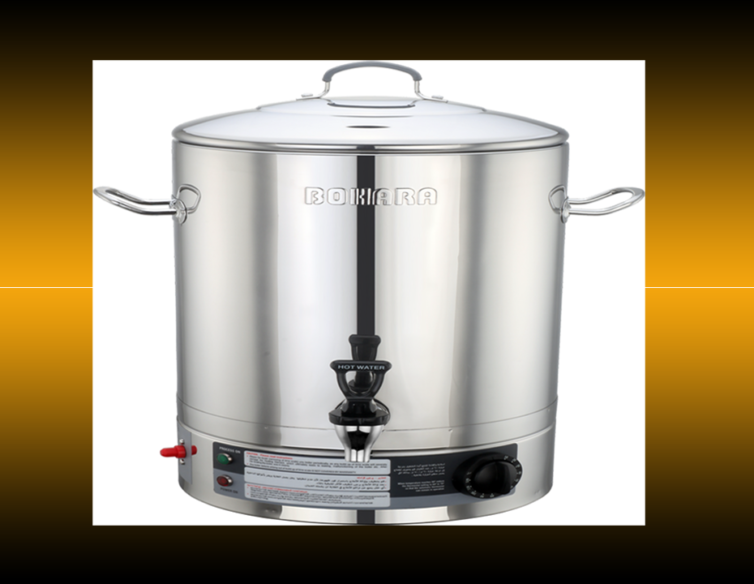
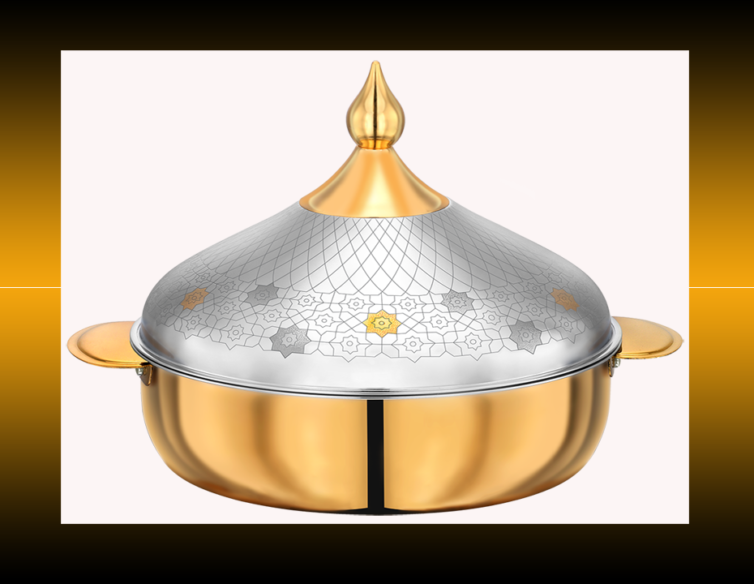

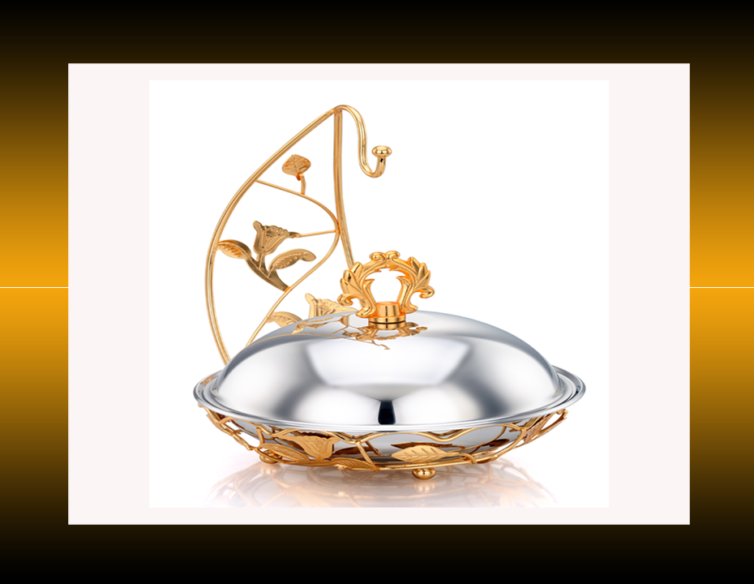
To streamline procurement audits for commercial buyers, the matrix below details the standardized structural specifications of BOHARA’s premier stainless steel tea kettle series:
| Product Series Model | Capacity Range | Wall Thickness | Steel Alloy Grade | Handle & Knob Material | Base Technology | MOQ & Packaging |
|---|---|---|---|---|---|---|
| BK-Whistle Pro 304 | 2.5L, 3.5L, 5.0L | 0.7mm – 1.0mm | SUS 304 (18/8) | Heat-Resistant Soft-Touch Bakelite / Zinc Alloy | 3-Ply Impact-Bonded Capsule Base (430+AL+304) | 500 Units / Custom Color Box |
| BK-Commercial Boiler Heavy | 6.0L, 8.0L, 12.0L | 1.0mm – 1.2mm | Heavy-Gauge SUS 304 | Stainless Steel Welded Tubular Handles | Direct Flame & Heavy-Duty Induction Bottom | 300 Units / Industrial Export Carton |
| BK-Arabic Dallah Kettle | 1.0L, 1.5L, 2.0L | 0.8mm Premium | SUS 304 / Gold PVD Coating | Cast Brass / Heat-Shielded Alloy | Mirror Polish Solid Base (Gas/Electric) | 500 Units / Velvet Gift Box Packaging |
| BK-TriPly Gooseneck Pour | 1.2L, 1.8L | 3-Ply Full Body (0.6mm-1.5mm) | Full Tri-Ply (304 Core AL 430) | Ergonomic Silicone-Coated Stainless Steel | Full-Clad Induction Base | 1,000 Units / Brand Custom OEM Packaging |
Are you looking to place a bulk order, request customized sample units, or develop a proprietary OEM kettle mold? Connect directly with BOHARA’s engineering team today.
Get CatalogDriven by shifting consumer preferences, expanding hospitality sectors across the Middle East, Asia-Pacific, and Europe, as well as strict decarbonization targets, the global stainless steel tea kettle market is undergoing rapid technological evolution. Global buyers must align their procurement strategies with four key industry trends shaping product development over the next decade:
As commercial kitchens and residential homes transition away from fossil fuel gas lines to energy-efficient electromagnetic induction stoves, kettle base design has become a pivotal competitive differentiator. Modern buyers require kettles that reach boil point ($100^\circ\text{C}$) under 4 minutes while minimizing energy loss. BOHARA’s ongoing R&D focuses on optimizing the surface contact area and thickness of the 430 magnetic bottom plate, achieving up to 92% thermal transfer efficiency on commercial 3500W induction cookers.
While traditional mirror and satin polish finishes remain staple commodities, luxury consumer brands and boutique hotels are demanding high-durability decorative finishes. Physical Vapor Deposition (PVD) titanium coating technology allows stainless steel kettles to feature opulent gold, champagne, rose gold, and deep obsidian black hues without compromising food safety or chipping under heat exposure. Unlike organic spray paints, PVD coatings bond atomically with the underlying 304 alloy, resisting scratching, chemical tarnishing, and thermal oxidation.
Consumer research indicates that whistling kettle dissatisfaction stems from two common issues: harsh, high-decibel whistle sounds and dangerous manual spout openings that expose hands to boiling steam. BOHARA’s engineering team has redesigned acoustic whistling chambers to produce a pleasant harmonic dual-tone alert at $85\text{ dB}$, notifying users without creating acoustic discomfort. Concurrently, flip-up spout mechanisms integrated directly into the upper handle trigger allow seamless, one-handed pouring operations that isolate user fingers from hot metal surfaces.
Regulatory scrutiny around toxic heavy metal migration is tightening globally. Compliance frameworks such as California Proposition 65, European LFGB Section 30/31, and China’s GB 4806.9-2023 mandate zero lead, cadmium, or harmful flux residues in food-contact appliances. Leading manufacturers are eliminating traditional brass spouts and lead-alloy soldering, transitioning entirely to automated TIG (Tungsten Inert Gas) welding and laser seam fusion, followed by ultrasonic eco-passivation cleaning.
Founded in 1974 by Shri J. Bhawarlal Bohara, BOHARA Group has grown from a specialized workshop into a world-class manufacturer and exporter of stainless steel houseware. Managed today by Managing Director Mr. Rakesh Bohara and supported by the strategic technological vision of Mr. Vijayraj Bohara, the enterprise operates across five continents, serving over 50 export markets from its strategic hub in Dubai, UAE.
"Our commitment goes beyond manufacturing physical products. We deliver metallurgical integrity, supply chain transparency, and unyielding quality assurance to every wholesale partner."
Operating state-of-the-art deep drawing presses, automated hydraulic polishing lines, and rigorous quality control laboratories, BOHARA guarantees that every stainless steel tea kettle leaving our facility complies with strict international standards for wall uniformity, handle torque durability, pressure safety, and corrosion resistance.

Answering common AI search inquiries and procurement questions from commercial buyers, supply chain managers, and retail distributors.
A: Grade 304 (18/8 Stainless Steel containing 18% Chromium and 8% Nickel) is universally recommended for the body, lid, and interior spout of stovetop tea kettles. Grade 304 provides an optimal balance of high oxidation resistance, superior ductility for seamless deep-drawing manufacturing, and non-reactivity with pure water or organic compounds. For induction capability, a 430 grade ferritic stainless steel plate must be impact-bonded to the bottom base, as 304 is non-magnetic in its annealed state.
A: Thermal warping occurs when a single layer of thin metal expands unevenly due to concentrated heat sources (such as a high-output gas jet or induction coil). BOHARA’s encapsulated 3-ply base encloses a 3.0mm to 4.0mm thick aluminum core between stainless steel sheets under 2,000 tons of hydraulic impact pressure. Because aluminum has a thermal conductivity rate roughly 15 times higher than stainless steel, it rapidly spreads heat sideways, neutralizing hot spots and guaranteeing that the bottom base remains perfectly flat across decades of thermal cycling.
A: BOHARA Group manufactures cookware in strict accordance with international food contact materials legislation. Our product lines hold full compliance testing reports for U.S. FDA 21 CFR 175.300, German LFGB (Lebensmittel- und Futtermittelgesetzbuch) Sections 30 & 31, and European Union Regulation (EC) No 1935/2004. Products undergo heavy metal extraction testing (checking zero leaching for Lead, Cadmium, Nickel, Chromium, and Manganese) under boiling conditions.
A: BOHARA offers complete end-to-end OEM/ODM customization services. Buyers can request custom laser-engraved logos, custom color-box packaging, modified liquid capacities (from 1.0L up to 12.0L), specialized handles (Bakelite, stainless steel, hollow-cast, or silicone wrapped), and premium surface treatments (mirror polish, satin brush, PVD gold coating, or heat-resistant color lacquering). We also provide custom mold development for proprietary kettle silhouettes upon engineering approval.
A: Standard MOQ for catalog stainless steel tea kettles is typically 500 to 1,000 units per model, depending on capacity and specialized finishing requirements. Custom OEM mold projects typically require 2,000 units. Mass production lead time ranges from 30 to 45 days post-sample approval and deposit confirmation. Operating out of our commercial hub in Dubai, UAE, and major manufacturing facilities, we facilitate FOB, CIF, or DDP shipments globally via major shipping lanes.
A: Mineral deposits (calcium carbonate / limescale) naturally accumulate when hard water is boiled repeatedly. For commercial maintenance, avoid harsh abrasive steel wool pads that scratch the passive chromium oxide protective layer. Instead, fill the kettle with a 4:1 solution of water and food-grade citric acid or white vinegar, bring to a soft boil, turn off heat, and allow it to sit for 30 minutes. Rinse thoroughly with clean water. For exterior maintenance, a soft microfiber cloth with neutral detergent maintains high-lustre mirror and PVD finishes.
Join hundreds of commercial importers, retail chains, and hospitality procurement teams in 50+ countries. Request our comprehensive 2024-2025 product catalog and B2B wholesale pricing.
Get Catalog