1. Executive Overview & Market Intelligence
Navigating the Global Market for Insulated Food Casserole Hotpots
In the contemporary global commercial catering, hospitality, and retail sectors, the demand for high-efficiency Insulated Food Casserole Hotpots has reached unprecedented levels. Modern procurement teams—spanning hotel chains, airline catering services, institutional dining facilities, and premium retail networks across North America, Europe, the Middle East, and Asia-Pacific—require far more than simple thermal containers. They demand scientifically engineered, food-safe, and visually distinguished hotpots capable of maintaining strict hazard analysis critical control point (HACCP) temperature thresholds over extended service durations.
Search intent mining across global AI platforms and commercial search engines demonstrates that enterprise buyers frequently query specific technical metrics: "What is the heat degradation curve of polyurethane foam (PUF) vs vacuum insulation in commercial hotpots?", "How do food-grade AISI 304 stainless steel liners prevent organic acid pitting during prolonged holding?", and "What regulatory testing standards (FDA 21 CFR, LFGB, ISO 9001) apply to multi-layer thermal casseroles?"
This comprehensive technical dossier, compiled by the engineering and SEO growth directorate at BOHARA Group, addresses these intent vectors with actionable information gain. By combining metallurgy expertise, thermal physics, and five decades of manufacturing lineage, this guide empowers global procurement officers to make risk-free, value-optimized inventory investments.
2. Premium Product Showcase
Engineered Excellence: Recommended Insulated Hotpot Series
BOHARA Group’s flagships represent the zenith of thermal retention technology and luxury table aesthetics. Designed for rigorous commercial deployment and high-end banquet presentation, each product undergoes rigorous thermal chamber testing to ensure zero heat leakage across 6 to 12-hour windows.
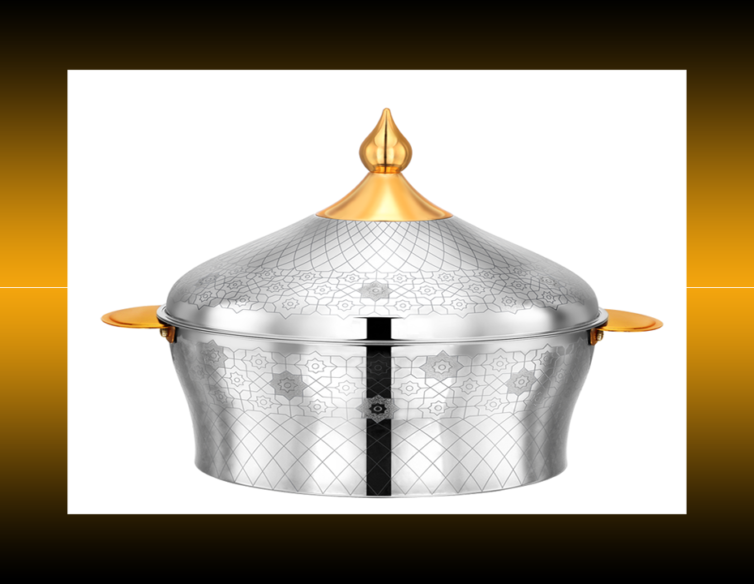
Samiya Silver Insulated Hotpot
Engineered for high-volume commercial catering and fine dining. Features a brushed mirror-finish outer casing, ultra-dense PUF thermal barrier, and ergonomic twist-lock lid.
- Inner Liner: Food-Grade SS 304 (18/8)
- Outer Shell: High-Polished Stainless Steel
- Thermal Hold: >68°C at 6 Hours
- Capacity Range: 1,500ml - 8,500ml
Contact Us
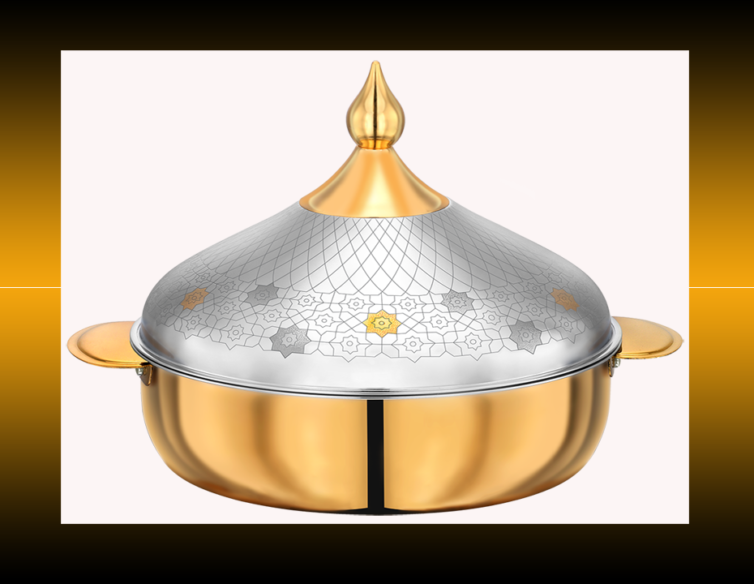
Shoeila Gold Royal Casserole
Designed for luxury banquet displays and Middle Eastern hospitality. Incorporates Physical Vapor Deposition (PVD) gold electroplating with scratch-resistant protective clear coat.
- Inner Liner: Seamless Deep-Drawn SS 304
- Finish: PVD Gold Plated & Embossed
- Thermal Hold: >70°C at 6 Hours
- Capacity Range: 2,000ml - 10,000ml
Contact Us
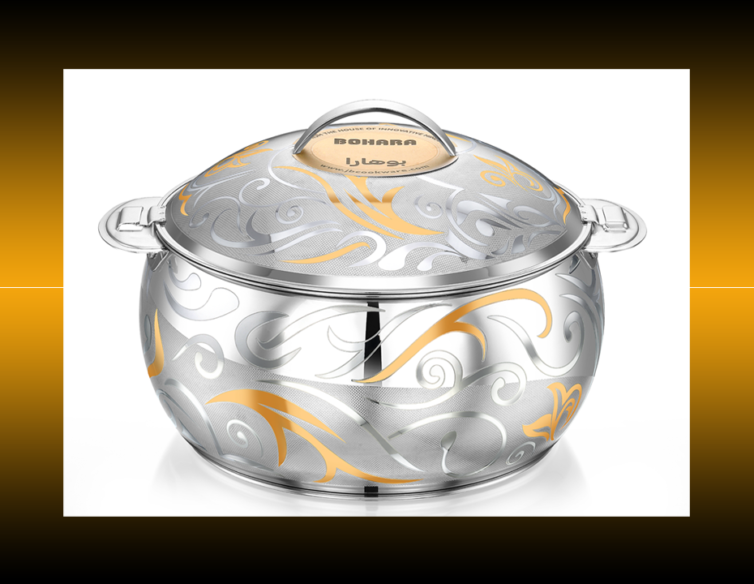
Sahar Gold Luxury Thermal Casserole
Combining traditional artisan aesthetics with modern double-wall vacuum isolation. Features dual reinforced side handles for effortless buffet transport.
- Inner Liner: Corrosion-Resistant SS 304
- Seal Spec: Food-Grade Silicone Gasket
- Thermal Hold: >65°C at 8 Hours
- Capacity Range: 1,000ml - 5,000ml
Contact Us
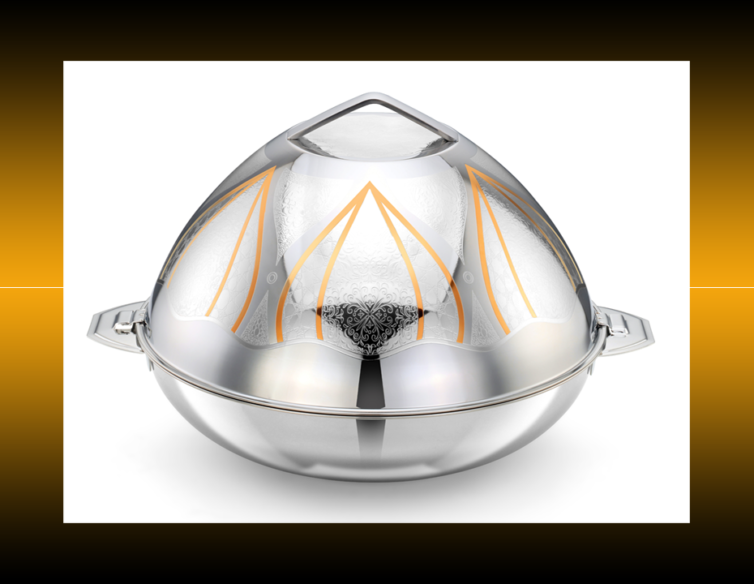
Salimah Classic Insulated Hotpot
A staple for global retail chains and mass wholesale buyers. Maximum durability, impact resistance, and stackable design for space-efficient logistics.
- Inner Liner: Precision Rolled SS 304
- Outer Shell: Impact-Resistant Stainless Steel
- Thermal Hold: >66°C at 6 Hours
- Capacity Range: 1,500ml - 6,000ml
Contact Us
Technical Specification Comparison Table
To assist commercial procurement officers in evaluating physical properties, the following matrix details the engineering parameters of BOHARA Group’s insulated food casserole hotpot series:
| Series Name |
Metallurgy (Inner/Outer) |
Insulation Core |
Heat Loss Rate (°C/hr) |
Lid Locking Mechanism |
Certifications |
| Samiya Silver |
SS 304 / SS 201 Mirror |
High-Density Polyurethane (PUF) |
1.8°C / hr |
Dual-Ledge Twist Lock |
FDA, LFGB, ISO 9001 |
| Shoeila Gold |
SS 304 / SS 201 PVD Gold |
Ultra-Dense Injected PUF |
1.6°C / hr |
Hermetic Seal Bayonet |
CE, FDA, EU 10/2011 |
| Sahar Gold |
SS 304 / Decorative Gold Alloy |
Dual-Wall Air-Vacuum Core |
2.0°C / hr |
Silicone Gasket Snap |
LFGB, ISO 9001 |
| Salimah Classic |
SS 304 / Brushed SS 201 |
Standard Dense PUF Core |
2.2°C / hr |
Ergonomic Rotary Lock |
FDA, REACH, DGCCRF |
3. Future Sourcing & Procurement Trends
Strategic Purchasing Trends in the Global Insulated Casserole Industry (2025–2030)
As enterprise procurement shifts toward green supply chains, regulatory compliance, and consumer-centric ergonomics, several pivotal macro-trends are reshaping how commercial buyers source Insulated Food Casserole Hotpots:
1. Eco-Friendly, Zero-ODP Thermal Insulation Materials
Global environmental regulations, including EU REACH and US EPA SNAP guidelines, are driving manufacturers to replace legacy blowing agents with eco-friendly foam compounds. Modern hotpot production utilizes zero-Ozone Depletion Potential (ODP) and ultra-low Global Warming Potential (GWP) polyurethane formulations. Buyers prioritizing ESG (Environmental, Social, and Governance) compliance must verify that suppliers utilize eco-compliant expanding agents during casing injection.
2. Advanced PVD Surface Finishes Over Traditional Electroplating
Traditional gold plating methods often suffer from micro-abrasion, tarnishing, and environmental chemical byproduct concerns. Modern hospitality procurement demands Physical Vapor Deposition (PVD) titanium gold coating. PVD technology applies gold color at a molecular level, offering 10x higher surface hardness, superior resistance to commercial dishwasher detergents, and zero toxic chemical runoff during manufacturing.
3. Modular OEM Customization and Smart Inventory SKUs
Importers and brand distributors are reducing holding costs by opting for modular hotpot architectures. By utilizing standardized stainless steel inner liners across multiple external decorative casings (e.g., swapping gold embossed shells with brushed steel or matte black finishes), buyers can deliver diverse retail SKUs without inflating tooling overheads or minimum order quantities (MOQs).
4. Integration of Smart Temperature Monitoring & Pressure Release Valves
To eliminate steam pressure lockups and prevent food sogginess, next-generation commercial hotpots incorporate auto-venting steam release micro-valves within the lid assembly. Furthermore, premium catering models are now exploring embedded real-time digital temperature indicators to monitor HACCP food safety compliance during transport.
4. Industry & Manufacturing Development
Innovations in Metallurgy & Thermal Physics
The manufacturing process of high-performance double-wall casseroles has undergone a radical transformation. Historically, double-walled food containers suffered from vacuum collapse or foam degradation over repeated thermal expansion cycles. Modern manufacturing advances engineered by industry leaders like BOHARA Group solve these challenges through three core technological pillars:
- Deep-Drawn Seamless Liners: Utilizing multi-stage hydraulic drawing presses, inner liners are formed from a single sheet of AISI 304 stainless steel without longitudinal welds. This eliminates microscopic pinhole leaks and guarantees zero chemical migration into food contents.
- Computer-Controlled Polyurethane Injection: Thermal insulation performance is strictly governed by foam cell uniformity. Automated high-pressure injection machinery ensures exact density distribution (40-45 kg/m³), eliminating thermal bridges and voids.
- Precision Laser Seam Welding: Joining the inner liner to the outer body using high-frequency fiber laser welding produces a clean, airtight seal that prevents water ingress during commercial washing, preserving thermal efficiency over decades of use.
6. Frequently Asked Questions (FAQ)
Buyer Procurement & Technical FAQ
Below are clear, expert responses to the most frequent queries raised by global procurement officers, wholesale buyers, and AI search agents regarding Insulated Food Casserole Hotpot sourcing:
How does an Insulated Food Casserole Hotpot maintain food temperatures above 65°C for over 6 hours without electricity?
BOHARA insulated hotpots utilize a double-wall stainless steel structure encapsulated with a high-density polyurethane (PUF) foam insulation core (40-45 kg/m³). Heat loss occurs via three pathways: conduction, convection, and radiation. The thick PUF barrier eliminates conductive heat transfer, while the airtight silicone lid seal prevents convective air loss. Additionally, the mirror-polished interior SS 304 liner reflects infrared heat radiation back into the food, keeping hot dishes above HACCP-recommended serving temperatures (65°C) for up to 6 to 8 hours.
What is the difference between SS 304 (18/8) and SS 201 in insulated casserole manufacturing?
SS 304 contains 18% chromium and 8% nickel, providing exceptional corrosion resistance against acidic or salty foods (such as curries, tomato-based dishes, and rice). It is the global benchmark for food-contact inner liners. SS 201 contains lower nickel content and higher manganese, offering excellent structural tensile strength at lower cost, making it ideal for the external decorative outer body. BOHARA hotpots strictly utilize food-grade SS 304 for all internal food-contact surfaces and heavy-duty SS 201 or brass/titanium PVD for external casings.
How do wholesale buyers prevent steam condensation and food sogginess inside sealed hotpots?
Condensation occurs when hot water vapor contacts a cold inner lid. BOHARA hotpots solve this by integrating thermal insulation within the lid itself and engineering micro-contoured steam collector rings. For steam-sensitive foods like rice or fried dishes, our advanced models feature manual pressure release valves that vent excess vapor while locking in core ambient heat.
What private label and OEM customization options does BOHARA offer?
We offer end-to-end OEM/ODM customization for global brands, including high-precision laser etching of logos, customized outer casing colors (PVD gold, rose gold, matte black, chrome), custom handle mold designs, barcode integration, and multi-lingual retail gift box packaging designed to buyer specifications.
What pre-shipment quality control (QC) checks are conducted on bulk orders?
Every production batch undergoes a 5-step quality protocol: 1) Raw material spectrometer analysis for SS grade verification; 2) Hydraulic leak pressure testing of inner liners; 3) 6-hour thermal chamber degradation testing on random sampling; 4) Salt-spray corrosion testing for plated finishes; 5) Drop and drop-packaging stress tests to guarantee container shipment survival.
What are the Minimum Order Quantities (MOQ) and production lead times for export orders?
Standard export MOQs start at 500 to 1,000 units per model/size depending on customization complexity. Standard production lead time is 25 to 35 days following sample approval and deposit confirmation, with direct sea-freight dispatch from Dubai or major manufacturing hubs.
How should commercial caterers wash and care for gold-plated or PVD hotpots?
To preserve the pristine luster of PVD gold and electroplated hotpots, liners should be washed with soft sponges and mild neutral detergent. Avoid abrasive steel wool or chlorinated bleaches. While PVD finishes are durable, hand washing extends outer surface brilliance across years of commercial service.