
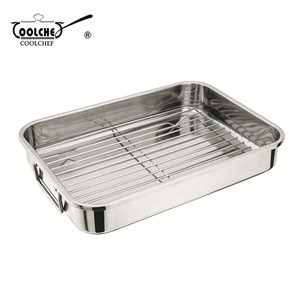
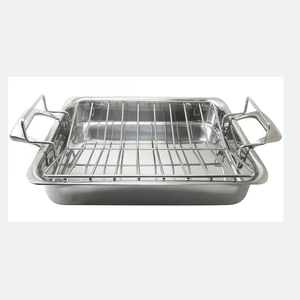
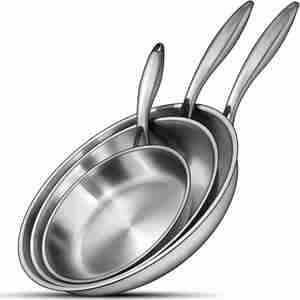
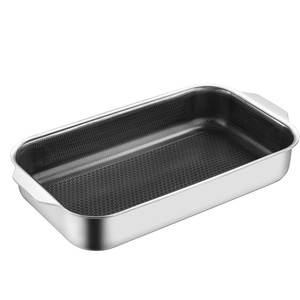
The Metallurgical Science Behind OEM 3-Ply Clad Stainless Steel Roasting Pans
An authoritative technical analysis of tri-ply bonding mechanics, heat flux optimization, and structural stability in commercial baking and roasting cookware.
In the high-intensity environment of commercial food service, catering, and professional culinary arts, roasting pans are subjected to severe thermal shocks, aggressive physical wear, and complex chemical environments. Traditional single-ply stainless steel cookware suffers from localized hot spots, poor thermal conductivity, and structural warping under sustained high heat. Conversely, disc-encapsulated aluminum base pans suffer from delamination risk and uneven heat distribution along the side sidewalls.
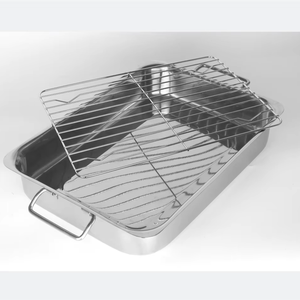
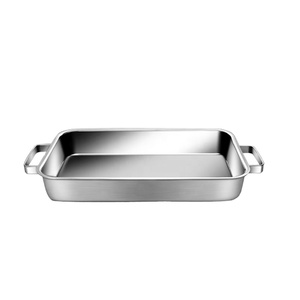
As a premier Custom OEM 3-Ply Stainless Steel Roasting Pan Manufacturer & Factory, BOHARA Group leverages advanced roll-bonding cladding technology to forge a unified 3-layer material matrix. This tri-clad architecture ensures seamless thermal conduction from the base all the way up the vertical sidewalls, optimizing roasting uniformity, juice retention, and energy efficiency.
Cross-Sectional Architecture of 3-Ply Clad Metal
The performance of a professional roasting pan depends on the precision of its metallurgic bond. Our OEM factory produces 3-ply cookware with a calibrated total thickness ranging from 2.0mm to 3.5mm, structured across three distinct functional alloys:
| Layer Position | Alloy Standard | Primary Engineering Function | Metallurgical Properties |
|---|---|---|---|
| Interior Layer (Food Contact) | SUS304 (18/8) / AISI 316 | Corrosion resistance, non-reactive cooking surface, easy sanitation. | Austenitic structure, high nickel content, zero metal leaching, acid-resistant. |
| Core Layer (Thermal Core) | Pure 1050 / 3003 Aluminum | Ultra-fast heat absorption, lateral heat spreading, hotspot elimination. | High thermal conductivity (approx. 200 W/m·K), low density, stress relaxation. |
| Exterior Layer (Cooktop Interface) | SUS430 (18/0) Ferritic Steel | Magnetic induction compatibility, structural rigidity, scratch resistance. | Ferromagnetic properties, high tensile strength, resistance to thermal expansion deformation. |
Thermal Conductivity & Structural Integrity Analysis
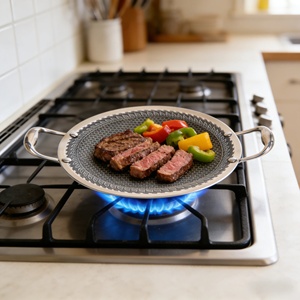
Roasting involves two distinct thermodynamic phenomena: direct conduction from the pan surface to the meat or vegetables, and indirect radiant/convective heating within the oven chamber. When deglazing a roast over a burner (transitioning from oven baking at 450°F to stove-top searing), a pan made of low-grade single-layer steel experiences differential expansion, resulting in bottom bowing (warping).
Our OEM factory addresses this through high-pressure cold-roll cladding combined with controlled atmosphere annealing. The outer SUS430 layer has a thermal expansion coefficient matched precisely to the internal pure aluminum core. This equilibrium preserves pan flatness over thousands of commercial cooking cycles, maintaining 100% surface contact with flat-top induction burners.
Zero Warping Guarantee
High-tonnage hydraulic deep drawing prevents stress concentration, ensuring flat bottom geometry even after rapid cold-water quenching.
Full-Rim Induction Response
The magnetic outer envelope guarantees rapid electromagnetic flux coupling on commercial induction hobs up to 3500W.
Food Safety Compliance
100% heavy metal leaching tested. Meets US FDA 21 CFR, EU LFGB, and German Food & Feed Code regulations for commercial contact.