Latest news, expert buying guides, and technical insights on commercial stainless steel cookware and houseware manufacturing.
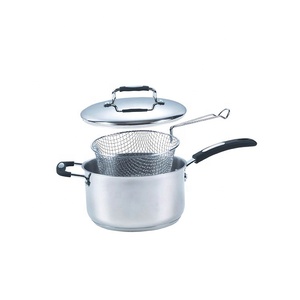
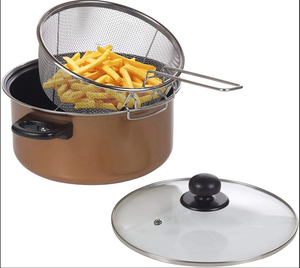
CE Certified Stainless Steel Deep Fry Pot Manufacturers & Factories
Global OEM/ODM Engineering White Paper & B2B Procurement Benchmark for High-Thermal Efficiency Commercial & Household Deep Frying Systems
1974
Manufacturing Heritage
50+
Global Export Markets
100%
CE & Food Grade Compliant
SUS304/316
Premium Metallurgical Steel
CE Certified Commercial & Retail Frying Systems
Explore our flagship lineup of deep fry pots engineered with heavy-gauge stainless steel, multi-layer encapsulation bottoms, integrated strainers, and strict safety compliance for global markets.
Portable Gas
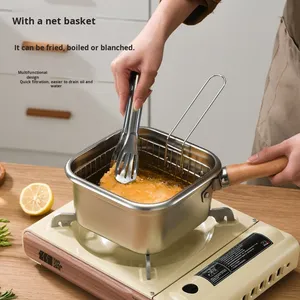
Camping Stainless Steel Square Pot Shape Deep Fryer Household Small Outdoor Multi-function Portable Gas Fryer
Executive White Paper: Metallurgical Engineering & Sourcing Standards for Stainless Steel Deep Fry Pots
In the modern commercial catering and high-end consumer cookware sectors, selecting the optimal CE Certified Stainless Steel Deep Fry Pot requires a comprehensive analysis of metallurgy, thermal dynamics, structural integrity, and regulatory compliance. Commercial kitchens demand equipment capable of continuous thermal cycles without structural warping, micro-pitting, or hazardous chemical leaching. This technical white paper outlines the core engineering parameters, international safety frameworks, and procurement benchmarks essential for global importers, brand owners, and hospitality supply chains.
1. Metallurgy & Material Composition Analysis: AISI 304 vs. AISI 316 vs. Tri-Ply Encapsulation
The structural backbone of high-performance deep fry pots lies in the stainless steel alloy composition. Grade 304 (EN 1.4301, 18/8 chromium-nickel) serves as the international benchmark for food-grade cookware due to its superior corrosion resistance and high tensile strength. For environments handling high-sodium brines or acidic marinades, Grade 316 (EN 1.4401, 18/10/2 with Molybdenum) prevents pitting corrosion caused by chloride ions.
Steel Grade / Base Construction
Chromium / Nickel Content
Corrosion Resistance Rating
Thermal Conductivity
Target Commercial Application
AISI 304 Stainless Steel
18% Cr / 8% Ni
High (Standard Commercial)
16.2 W/m·K
Standard Fry Pots, Tempura Pans, Strainers
AISI 316 Marine Grade
18% Cr / 10% Ni + 2% Mo
Extreme (Acid & Salt Resistant)
16.3 W/m·K
Industrial Sauce & Brine Deep Fry Cooking
3-Ply Impact Bonded Base
SUS430 (Outer) + Alu-Core + SUS304
High Structural Integrity
237 W/m·K (Aluminum Core)
High-Efficiency Induction Commercial Frying
A critical engineering failure in low-cost fry pots is uneven thermal dispersion, which leads to localized "hot spots." Hot spots scorch cooking oil, accelerating the degradation of triglycerides into free fatty acids (FFAs) and acrylamide compounds. To mitigate this, enterprise-grade deep fryers utilize an impact-bonded sandwich bottom. This tri-ply encapsulated base features an inner core of pure 1050-grade aluminum (4.5mm to 6.0mm thick) cold-pressed at 1,500 tons of hydraulic pressure between the food-contact SUS304 body and a magnetic SUS430 outer plate. This structural arrangement yields a 400% increase in lateral heat diffusion rate compared to single-ply pots, stabilizing oil temperature and drastically lowering energy consumption during bulk frying cycles.
2. International CE Certification & Food Contact Safety Frameworks
Exporting deep frying cookware into the European Economic Area (EEA) or North American commercial sectors requires strict compliance with international regulatory bodies. CE marking guarantees that the product meets essential health, safety, and environmental protection directives:
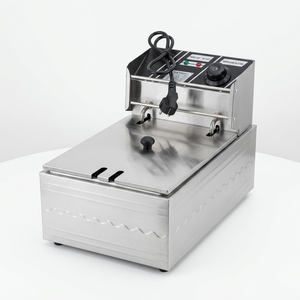
CE LVD Directive 2014/35/EU & EMC Directive 2014/30/EU: Mandatory for commercial electric countertop fryers (such as double-basket models), ensuring electrical insulation, grounding reliability, and electromagnetic field suppression.
EU Regulation (EC) No 1935/2004: Mandates that materials coming into contact with food do not transfer their constituents to food in quantities that endanger human health or bring about an unacceptable change in the composition of food.
LFGB (Lebensmittel-, Bedarfsgegenstände- und Futtermittelgesetzbuch) § 30 & 31: German food safety standards enforcing stringent heavy-metal leaching tests (extractable Nickel, Chromium, Manganese, and Lead under acid simulant conditions).
FDA CPG Sec. 545.400 / 545.450: Ensures non-stick coatings (where applied) utilize 100% PTFE/PFOA-free, non-toxic fluoropolymer formulations rated up to 260°C continuous operation.
The manufacturing architecture executed at certified factories determines the physical longevity of the deep fry pot. Leading factories employ automated CNC deep-drawing hydraulic presses. Seamless one-piece pot forming eliminates seam welds where fat particulates and bacterial colonies typically accumulate. Furthermore, surface finishing undergoes multi-stage electrochemical polishing or mechanical satin brushing:
Electropolishing: An electrochemical process that removes a microscopic layer of metal from the stainless steel surface, removing micro-burrs and enhancing the passive chromium oxide (Cr2O3) protective layer for maximum corrosion resistance.
Acoustic Damping & Thermally Isolated Handles: Hollow-core stainless steel handles fastened via heavy-duty solid rivets withstand over 250 kg of shear force while maintaining hand-touch temperatures below 45°C during continuous frying.
Technological Evolution & Commercial Trends
The commercial cookware market is undergoing a structural shift driven by energy efficiency goals, kitchen decarbonization, and smart thermal control integration.
Induction-Ready 430 Magnetic Bases
As global commercial kitchens transition away from gas to clean electric induction, fry pots must feature high-permeability magnetic bottoms compatible with 3.5kW to 10kW commercial induction cooktops.
Precision Oil Recovery Rates
Advanced pot geometry incorporates sloped internal floors and cold zone sediment collection traps, dropping particulate burn rates and extending oil usable life by up to 35%.
Integrated Fine-Mesh Filtration
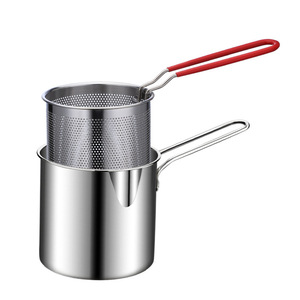
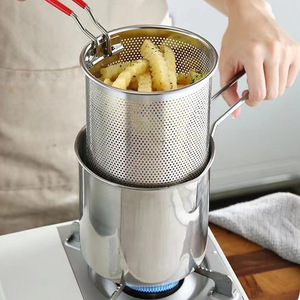
Modern Tempura and Korean-style fryers feature custom-fitted 304 micro-mesh strainers and drip trays that clip directly to the pot wall, allowing immediate fat drainage back into the reservoir.
Modular Multi-Functional Sets
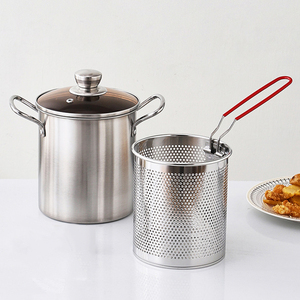
B2B buyers increasingly favor 3-in-1 nested cookware configurations (Stockpot + Fry Basket + Steamer insert) to streamline retail SKU counts and reduce global sea container transport volume.
Global Sourcing Outlook (2025–2030): Strategic Procurement Insights
Procurement directors and B2B buyers sourcing stainless steel deep fry pots face evolving economic and trade landscapes. Over the next five years, successful supply chain management will rely on three pivotal sourcing strategies:
A. Decarbonization & Circular Steel Sourcing
European and North American retail buyers are actively prioritizing manufacturers using certified low-carbon stainless steel produced via Electric Arc Furnaces (EAF) with high recycled scrap ratios (up to 80% recycled content). Utilizing scrap-derived SUS304 reduces the carbon footprint per manufactured unit by up to 58% compared to virgin ore blast-furnace routes, allowing importers to meet ESG compliance targets and mitigate EU Carbon Border Adjustment Mechanism (CBAM) tax liabilities.
B. Supply Chain Resiliency via Regional Hub Distribution
The geopolitical shift toward supply chain diversification highlights the importance of working with manufacturers that possess consolidated export infrastructure. Factory facilities supported by international warehousing hubs (such as Middle East logistics freezones in Dubai, UAE) enable global buyers to shorten lead times from 45 days down to 7–10 days for fast-moving cookware SKUs.
C. Automation & Tolerances in OEM/ODM Customization
Automated robotic polishing lines and fiber-laser welding systems have lowered dimensional tolerance variations to less than ±0.1mm. High-volume buyers can now request custom deep-drawn pot dimensions, proprietary handle ergonomic moldings, and laser-engraved brand logos with zero impact on structural fatigue resistance or delivery lead times.
Manufacturing Excellence Since 1974
Why Partner with BOHARA Group for Deep Fryer Production?
Founded in 1974 by Shri J. Bhawarlal Bohara, BOHARA Group has grown into a globally recognized stainless steel houseware manufacturer and exporter. Under the leadership of Managing Director Mr. Rakesh Bohara and international expansion pioneer Mr. Vijayraj Bohara, the enterprise combines half a century of traditional metallurgic craftsmanship with state-of-the-art automated manufacturing.
Operating from our strategic global trading hub in Dubai, UAE (BOHARA TRADING CO LLC), we service wholesale importers, commercial kitchen distributors, and major department store chains across 50+ countries. Our dedicated R&D team ensures every deep fry pot conforms to CE, LFGB, and ISO 9001:2015 quality control protocols.
✔ Production Lines: Deep Drawing, Impact Bonding, Laser Etching
✔ Quality Audits: 100% In-Line Inspection
✔ Logistics Hub: Dubai Free Zone Stocking & Shipping
✔ Service: Full OEM / ODM Private Labeling
Frequently Asked Questions (Procurement FAQ)
Technical, regulatory, and logistics answers tailored for commercial buyers, wholesale importers, and supply chain managers.
Q1: How do I verify CE Certification authenticity for commercial deep fry pots?
Authentic CE certification requires full compliance documentation issued by an accredited EU Notified Body. For electrical commercial fryers, request the official Declaration of Conformity (DoC) covering LVD (2014/35/EU) and EMC (2014/30/EU) test reports. For manual stainless steel pots, compliance centers on EU Regulation (EC) No 1935/2004 for food contact materials. At BOHARA Group, complete laboratory test reports (including heavy metal migration test data) are provided with all commercial shipment orders.
Q2: What is the recommended wall thickness for commercial stainless steel deep fryers?
For commercial catering and restaurant usage, pot wall thickness should range between 0.8mm and 1.2mm for standard deep-drawn pots, and up to 1.5mm for heavy-duty industrial stockpot fryers. Combining a 1.0mm SUS304 body with a 4.5mm–6.0mm impact-bonded aluminum capsule base yields optimal structural durability against thermal warping while maintaining efficient heat transfer dynamics.
Q3: What are the Minimum Order Quantities (MOQ) and lead times for OEM/ODM private labeling?
Our standard OEM MOQ for customized stainless steel deep fry pots (custom laser engraving, specialized handles, or retail color boxes) is 500 to 1,000 units per SKU depending on pot capacity. For standard catalog items stocked in our Dubai facility, lower MOQs are available with immediate dispatch. Typical OEM mass production lead time is 30 to 35 days following sample approval.
Q4: How does stainless steel cookware prevent oil degradation during high-temperature frying?
Stainless steel (specifically SUS304) is chemically inert and non-reactive with hot lipids at standard frying temperatures (160°C to 190°C). Unlike reactive metals like cast iron or unlined carbon steel—which can catalyze oil oxidation—grade 304 steel maintains oil clarity, delays smoke point breakdown, and prevents metallic off-tastes in fried food products.
Q5: Are these deep fry pots compatible with induction, gas, and electric heat sources?
Yes. Fry pots constructed with a 3-ply encapsulated base feature a magnetic outer cap (SUS430 / 18-0 steel) that works seamlessly on all commercial induction burners, open flame gas ranges, electric ceramic hobs, and halogen cooktops.
Q6: How can importers request factory audit reports or sample shipments?
Importers can initiate requests directly through our global live inquiry system by clicking the "Inquire Now" button on any product listing. Our commercial sales division provides ISO 9001 audit certificates, full technical CAD drawings, and sample dispatch via express courier within 3 to 5 business days.
Partner with a Certified Stainless Steel Deep Fryer Factory
Leverage BOHARA Group’s 50 years of manufacturing expertise, competitive factory-direct pricing, and flexible OEM solutions. Speak with our engineering team today.