
A Stainless Steel Kadahi With Lid is a deep, rounded cooking vessel designed for Indian and South Asian cuisine. It usually has sturdy side handles, a broad cooking surface, and a matching cover. The curved shape helps ingredients move toward the center while stirring. This makes it useful for curries, biryani, sautéed vegetables, fried snacks, and slow-cooked sauces. The lid traps steam and heat. It can also reduce splattering during vigorous cooking.
Its stainless steel body resists rust, absorbs little odor, and suits regular kitchen use. Many models work on gas, electric, ceramic, or induction stoves. Compatibility still needs checking. Some kadahis use an aluminum or copper core for better heat distribution. Others may develop hot spots, especially over high heat. A thick base often performs more steadily than a very thin one. That detail matters.
In practical use, preheating should be gentle. Adding oil before the vessel becomes excessively hot can reduce sticking. The rounded walls also require a suitable spatula, preferably one that reaches the edges. Handles may become hot, even when the lid stays cooler. Basic caution is essential.
A good Stainless Steel Kadahi With Lid is not automatically perfect. Weight, base construction, lid fit, and cleaning effort affect its value. Water spots may appear after washing. They are usually cosmetic, but they can frustrate careful cooks. This guide examines the vessel’s structure, cooking performance, maintenance, and buying considerations with practical accuracy.
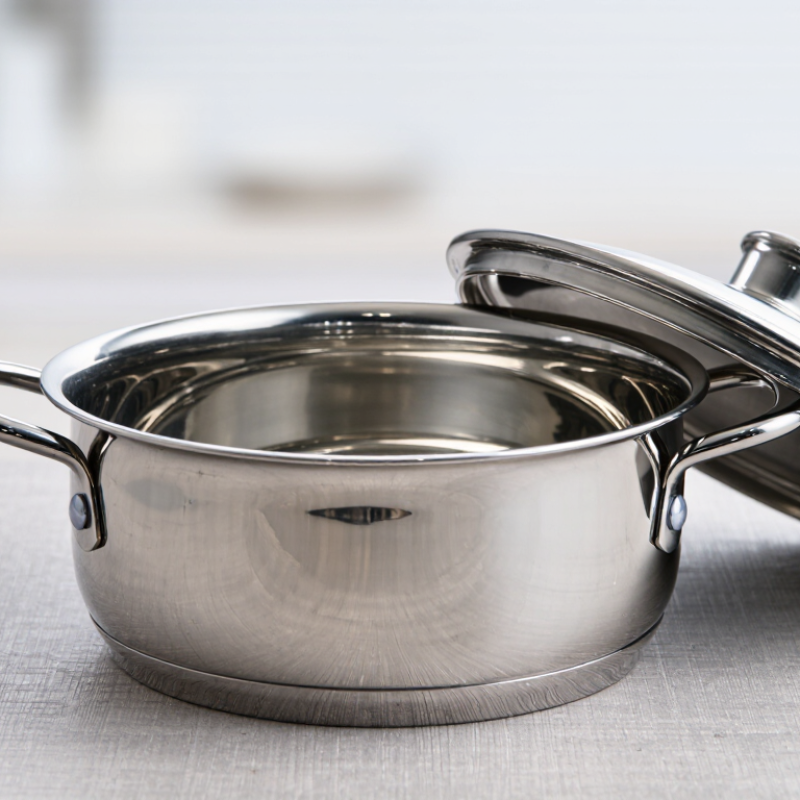
What Is a Stainless Steel Kadahi With Lid?
A stainless steel kadahi with lid is a deep, rounded cooking vessel designed for frying, simmering, and slow cooking. Its broad opening allows easy stirring, while its curved sides help circulate food and heat. The lid retains moisture and reduces splashing during cooking.
Its anatomy includes a sturdy rim, rounded walls, a flat or slightly curved base, and two side handles. Some models also include a helper handle for safer lifting. The lid may have a raised grip and a small steam vent. Handles should feel balanced, remain secure, and stay reasonably cool during normal use. Small details matter.
Stainless steel resists rust, staining, and flavor absorption when properly manufactured and maintained. However, not every stainless steel grade performs identically. Food-contact suitability depends on the material, construction, and applicable safety standards. A thick base can improve heat distribution, especially on modern stovetops, though it may not eliminate hot spots completely. I have found that preheating gently and adding oil afterward often reduces sticking. Still, this method is not foolproof. The kadahi needs careful temperature control.
A well-fitted lid should sit steadily without trapping excessive pressure. It should also be easy to remove with a dry, heat-resistant grip. After cooking, washing by hand can protect the finish, although many stainless steel kadahis tolerate dishwasher cleaning. Drying promptly helps prevent water marks. Practical design beats decoration.
| Dimension / Component | Typical Data | Definition and Function |
|---|---|---|
| Definition | Deep, wide stainless-steel cooking vessel supplied with a fitted lid | A kadahi, also spelled kadai or karahi, is a rounded cooking pan used for frying, sautéing, simmering, reducing sauces, and preparing one-pot dishes. The lid helps retain heat and moisture. |
| Main body material | Food-contact stainless steel, commonly in the 18/8 or 18/10 category | Stainless steel provides corrosion resistance, a non-reactive cooking surface for most foods, and durability. The exact alloy and thickness vary by product. |
| Overall diameter | Approximately 20–32 cm (8–12.5 in) | Measured across the upper rim. Smaller sizes suit individual or small-family portions, while larger sizes are useful for batch cooking. |
| Usable capacity | Approximately 1.5–5.0 L | Capacity depends on diameter, wall height, and the rounded shape. For safer cooking, the vessel should not be filled to the rim. |
| Cooking depth | Approximately 7–14 cm (2.8–5.5 in) | The deep profile contains oil, sauces, and larger food portions more effectively than a shallow frying pan. |
| Base construction | Single-layer or bonded multi-layer base | A bonded base may include an aluminum or copper heat-spreading layer enclosed beneath stainless steel. This improves heat distribution while keeping the cooking surface stainless steel. |
| Induction compatibility | Depends on the base design | Magnetic stainless steel or a magnetic stainless-steel base is required for induction cooking. A product label or magnet test can help verify compatibility. |
| Side walls | Rounded or gently sloped walls | The curved walls make it easier to stir, toss, and scrape food from the sides while supporting even contact with cooking utensils. |
| Handles | One long handle, two side handles, or both | Handles provide control during stirring and lifting. Their heat resistance depends on the material, attachment method, and cooking temperature. |
| Lid material | Stainless steel, tempered glass, or a combination | A stainless-steel lid is durable and opaque. A glass lid allows visual monitoring. The lid should fit securely without blocking normal steam release. |
| Lid knob or handle | Metal or heat-resistant polymer | The top grip allows the lid to be lifted. Metal grips can become hot, so an oven mitt or kitchen towel may be needed. |
| Typical cooking methods | Deep-frying, shallow-frying, sautéing, braising, simmering, and steaming | Its depth and rounded base support both high-heat cooking and covered, moisture-based recipes. |
| Heat response | Varies with steel thickness and base layers | Thin single-layer steel heats and cools quickly but may develop hot spots. A thicker or bonded base generally distributes heat more evenly. |
| Care requirements | Hand washing or dishwasher cleaning, subject to product instructions | Allow the vessel to cool before washing, use a non-abrasive cleaner, and dry it promptly to reduce water spots and discoloration. |
| Primary advantages | Durability, versatility, corrosion resistance, and a non-reactive surface | A lidded stainless-steel kadahi can move from browning or frying to covered simmering, making it suitable for everyday cooking and batch preparation. |
Note: Dimensions, capacity, handle configuration, alloy specification, and cooktop compatibility vary among individual stainless-steel kadahi models.
It is a deep, rounded cooking vessel with sloping sides and a matching lid. The curved base helps stirring.
Many models use 304 stainless steel, containing about 18% chromium and 8% nickel. It resists moisture and food acids.
No. Not rust-proof. Salt residue, moisture, and poor drying can leave faint marks near the rim.
It usually combines stainless steel, an aluminum core, and another stainless layer. The aluminum spreads heat and may reduce hot spots.
No. Layer thickness, construction, and finishing still matter. A label alone proves very little.
Look for a flat, stable base and a lid that fits closely. Check handles, seams, and the inner surface for rough areas.
Leave practical headspace instead of filling it completely. This reduces boil-over and makes stirring and lifting safer.
Remove residue, wash with mild detergent, rinse, sanitize when needed, and air-dry. Avoid steel wool and harsh powders.
It helps reduce splashing and retain heat. It does not replace careful temperature control or safe handling.
I would not assume that. A rushed wash can leave oily film in the curved bottom, and the lid rim needs inspection.
A Stainless Steel Kadahi With Lid is a deep, rounded cooking vessel designed for sautéing, frying, simmering, and preparing foods that require generous stirring space. Its lid helps retain heat and moisture while reducing splatter. The vessel is commonly made from 304 stainless steel, an austenitic alloy containing approximately 18% chromium and 8% nickel. Chromium supports corrosion resistance, while nickel contributes to durability and a stable, polished surface.
For reliable performance, the body may follow ASTM A240 sheet standards, while a tri-ply base can combine stainless steel with a conductive aluminum core to distribute heat more evenly. At 20°C, 304 stainless steel has a thermal conductivity of about 16 W/m·K, so the layered base is especially useful for reducing hot spots. Food-contact use should follow applicable FDA Food Code principles, including suitable materials, correct capacity, and thorough cleaning. Proper care involves washing after use, drying promptly, avoiding harsh abrasives, and selecting a size that allows safe cooking without overfilling.