
Knowledge & Industry Updates
Latest news, expert buying guides, and technical insights on commercial stainless steel cookware and houseware manufacturing.
Choosing a Professional Nonstick Frypan is not just about picking the slickest surface. It is about matching construction, coating, and heat performance to the way you cook. Grand View Research valued the global cookware market at approximately USD 23.8 billion in 2023 and forecast continued growth through 2030. That expansion means more options on the shelf, but a larger market does not guarantee a better pan.
Look beyond the label. A useful comparison checks the pan’s base thickness, handle stability, cooking-surface dimensions, and stated care instructions. For example, a heavy base may help distribute heat across eggs or a thin crepe, while a loose handle can make even a well-coated pan awkward. Consumer Reports’ cookware testing also emphasizes practical performance, including heating and ease of use—not appearance alone. Check whether testing applies to the specific model, since results can vary across product lines.
Details matter.
This guide explains how to assess those features, compare product claims, and choose a pan suited to your stove and routine. It also treats durability claims with some caution: coating life depends on heat, utensils, cleaning, and frequency of use. No pan stays perfect forever. A careful choice can still make everyday cooking more predictable, with fewer frustrating hot spots and less food stuck to the surface.
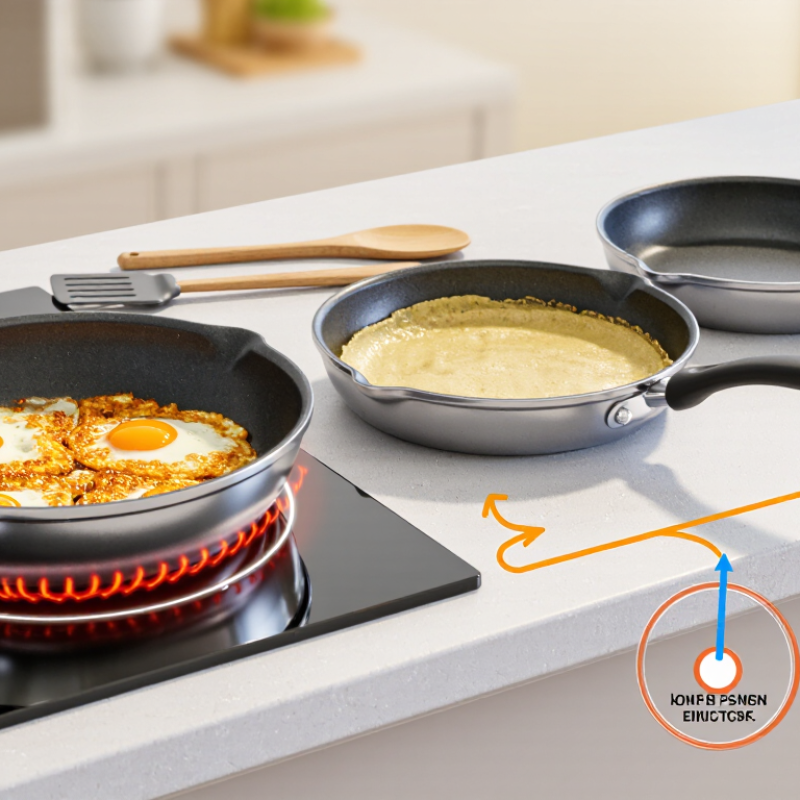
Choose the pan around the meals you actually cook. Eggs, pancakes, and delicate fish suit a light, shallow frypan with a gently sloped rim; food lifts easily, and flipping feels less clumsy. For sautéed vegetables or chicken, choose a wider cooking surface and a sturdy base that stays level on the hob. A small admission: larger pans can seem more versatile, but they are awkward when you are cooking one egg.
Base material affects heat response. ASM International’s ASM Handbook, Volume 2, lists thermal conductivity around 150–220 W/m·K for many aluminum alloys, compared with roughly 15–20 W/m·K for common austenitic stainless steels. These are approximate ranges; alloy and construction matter. An aluminum-core base can spread heat quickly, while a heavier pan may feel steadier when searing. Check the usable flat area, not just the rim diameter. That detail matters. Also match the pan’s weight to your grip and storage space. If you often cook with little oil, prioritize a smooth, undamaged nonstick surface and use utensils that will not scratch it. A pan that fits your routine is more useful than one with the longest feature list.
Typical cooktop compatibility by pan base construction. Induction cooktops require a magnetic base.
How to use this: If you cook on induction, choose a frypan with a magnetic base and check the manufacturer’s cooktop guidance. For other cooktops, prioritize a pan style and size that suit your usual portions and cooking tasks.
A professional nonstick frypan should match the coating to the work and the care you can realistically provide. PTFE-coated pans usually release delicate foods, such as eggs or flaky fish, with little oil. They need moderate heat; prolonged high heat can damage the coating. Use silicone or wooden tools, and avoid cutting food in the pan.
Ceramic-coated pans are often chosen for their smooth feel and simple cleanup. Their release performance may fade with wear, especially when repeatedly overheated or scrubbed with abrasive pads. Not forever. A pale omelet sliding easily on the first day is no guarantee it will do so after months of daily use. That is worth considering before paying extra for a particular surface.
Care matters for both types. Let the pan cool before washing; sudden temperature changes can stress the body or coating. Use warm water, mild dish soap, and a soft sponge, then dry it fully. Stack pans with a cloth or protector between them to prevent scratches. If food starts sticking, reduce the heat and check for residue before assuming the coating has failed. Follow the maker’s care instructions, since temperature limits and cleaning guidance vary by pan.
A professional nonstick frypan should match its material to how you cook. ASM Handbook material tables show that aluminum conducts heat far better than stainless steel, while copper conducts better still. The Copper Development Association reports copper conductivity near 400 W/m·K; aluminum is roughly 237 W/m·K. These are material figures, not guarantees for a finished pan: thickness and bonded layers matter. Look for a flat, evenly built base, especially if you cook eggs over a low flame or sear vegetables on an electric hob. Small detail. A thin base may heat unevenly.
Check the handle as carefully as the cooking surface. Hold the pan as if it were full, and notice whether the handle feels balanced, secure, and comfortable with a dry oven mitt. Rivets can collect residue, while a smooth joint is easier to wipe clean. Metal handles may become hot; silicone or other heat-resistant grips can have lower oven limits. Read the maker’s stated temperature rating rather than guessing. It is an easy detail to miss.
Heat compatibility matters. Induction cooktops need a magnetic base; a household magnet offers a quick check. Gas pans should sit steadily on the grate, with flames kept beneath the base rather than licking the sides. For coated pans, avoid sudden high heat and follow the stated oven limit. There is a trade-off: the fastest-heating pan is not always the easiest to control. A little imperfect, perhaps—but steady heat and a secure grip usually matter more than a shiny finish.
Choosing a professional nonstick frypan starts with how you cook, not the largest size on the shelf. For one or two portions, a 24–26 cm pan usually gives eggs or a chicken breast room to lie flat. A 28–30 cm pan suits family servings, but only if your burner heats it evenly. Measure the cooking surface, not just the rim; sloped sides can make the usable base much smaller. Small detail.
Depth is easy to overlook. A shallow pan makes turning pancakes and sliding omelets simple, while higher sides help contain vegetables and oil during sautéing. If you often cook saucy dishes, choose a little more depth, but do not expect a frypan to replace a saucepan. Check how the handle sits in your hand, too. A full pan of potatoes can feel surprisingly heavy.
Weight should balance control and comfort. A very light pan moves easily, yet may feel less steady when stirring; a heavier base can hold heat better, though it may tire your wrist. Lift the empty pan and tilt it as if pouring. If that motion feels awkward, food will not make it better. I may be overemphasizing wrist comfort here; cooks who prepare large meals may value capacity more. Your burner size and the pan’s balance matter just as much.
A professional nonstick frypan should feel safe in ordinary use, not just look reassuring on a package. Check the coating description, handle stability, and care instructions. The German Federal Institute for Risk Assessment (BfR) reports that PTFE coatings can begin to decompose at about 360°C, releasing gases that may be harmful. That is far above normal frying temperatures, but an empty pan left over high heat can approach the danger zone. Use moderate heat. A lid, sturdy handle, and clear cleaning guidance matter more than glossy claims. Scratches are easy to miss.
Durability is harder to judge in a shop. Look for a flat base, smooth rivets, and a coating that appears even under bright light. A long warranty helps only if it covers coating wear, not merely manufacturing defects; read the exclusions before paying more. Compare price with realistic service life, too: an illustrative $40 pan replaced every two years costs $20 per year, while a $90 pan lasting five years costs $18 per year. Those lifespans are examples, not guarantees. Even a careful checklist cannot predict every failure, and I would not treat a high price as proof of a better coating. Choose a pan whose safety guidance, warranty terms, and replacement cost you can verify.
| Evaluation Dimension | What to Check | Practical Benchmark | Caution Signs | Suggested Weight |
|---|---|---|---|---|
| Coating safety and care | Identify the coating type and read the manufacturer’s instructions for temperature limits, utensils, and cleaning. | Choose cookware with clear care and temperature guidance. PTFE-coated pans are intended for normal cooking when used as directed; avoid heating an empty pan and avoid overheating it. | Vague coating descriptions, missing use instructions, or advice to preheat an empty pan on high heat. Overheated PTFE coatings can release fumes hazardous to birds and potentially irritating to people. | 30 points |
| Coating durability | Check care requirements, coating coverage, and whether the pan is suitable for your cooking habits. | Look for an even, undamaged cooking surface and care instructions that match your routine. Use utensils and cleaning methods approved for that coating; hand-washing often helps preserve nonstick surfaces. | Scratches, chips, peeling, or a surface that is already uneven. Do not assume that a “ceramic” or “reinforced” label guarantees a longer service life. | 25 points |
| Body and construction | Assess the pan’s material, base stability, handle attachment, balance, and compatibility with your cooktop. | The pan should sit flat, feel balanced when lifted, and have a firmly attached handle. Confirm induction compatibility if you use an induction cooktop. | A rocking base, loose handle, sharp edges, or unclear cooktop compatibility. A heavier pan is not automatically better if it is difficult to handle safely. | 10 points |
| Warranty and support | Read the written warranty, coverage period, claim process, and exclusions before buying. | Prefer clear terms that explain what defects are covered, how to submit a claim, and what proof of purchase is required. | Assuming normal coating wear is covered. Many cookware warranties exclude damage from overheating, misuse, abrasion, or ordinary wear; the exact terms vary by seller and product. | 15 points |
| Price and value | Compare similar pan sizes and construction, then consider expected use, care requirements, and replacement cost. | Compare total value rather than price alone. A useful calculation is purchase price divided by the number of years you reasonably expect to use the pan. | Paying a premium based only on “professional,” “eco,” or “long-lasting” wording without clear specifications, care guidance, or warranty terms. | 15 points |
| Fit for your cooking needs | Check pan diameter, usable flat cooking area, weight, handle comfort, and oven-safe limits. | Choose a size that fits your usual portions and cooktop. Confirm oven limits for the pan and handle separately, and follow the lower stated limit. | Assuming every nonstick pan is oven-safe, dishwasher-safe, or suitable for high-heat searing. Verify each claim in the product instructions. | 5 points |
Suggested scoring: Rate each dimension from 0 to 5, then multiply the rating by its weight and divide by 5. Use the score to compare options with similar size and intended use; always follow the pan’s own safety and care instructions.
Aluminum conducts heat well, while copper conducts even better. Stainless steel conducts less efficiently. Thickness and bonded layers still matter.
Look for a flat, evenly built base. A thin base may heat unevenly, especially when cooking eggs over low heat.
Hold the pan as if it were full. Check its balance, grip, and stability while wearing a dry oven mitt. Small detail.
No. Metal handles can become hot, and heat-resistant grips may have oven limits. Check the stated temperature rating.
Place a household magnet against its base. If it sticks, the base is magnetic. That is a quick check, not a full performance guarantee.
Use moderate heat and avoid heating an empty pan for long. Follow its oven limit and keep gas flames beneath the base.
Check for a flat base, smooth rivets, and an even-looking coating under bright light. Scratches can be easy to miss.
Not necessarily. Read whether it covers coating wear or only manufacturing defects. A high price alone does not prove better quality.
Estimate cost per year using realistic service life. For example, a $40 pan lasting two years costs about $20 yearly. Those lifespans are not promises.
Choosing a Professional Nonstick Frypan starts with considering the meals you cook most often. Think about whether you need a pan for delicate eggs, quick sautéing, or larger portions, then compare coating types and the care they require. Some coatings are better suited to gentle utensils and moderate heat, while others may offer different maintenance needs. Following the care instructions can help preserve the nonstick surface and extend the pan’s useful life.
Next, assess the pan’s body material, handle comfort, and compatibility with your cooktop and oven. Choose a diameter, depth, and weight that feel manageable and suit your usual serving sizes. Finally, compare safety information, expected durability, warranty terms, and price rather than choosing by cost alone. A well-matched pan should be comfortable to use, easy to care for, and appropriate for your cooking habits.