
Arabic coffee is entering more homes, hotels, restaurants, and cultural venues worldwide. The Arabic Coffee Pot Dallah remains central to that experience. It is not merely a serving vessel. Its curved body, long spout, wooden handle, and polished surface communicate hospitality before the first pour.
The International Coffee Organization reported global coffee consumption at about 177.9 million 60-kilogram bags in 2023/24. This expanding coffee culture creates new opportunities for dependable dallah suppliers. However, market growth does not guarantee product quality. A bright finish can hide a weak seam. A traditional shape may still pour poorly.
Food historian Nawal Nasrallah describes Arabic coffee service as “a ritual of hospitality.” That perspective matters when comparing international suppliers. Buyers must examine material thickness, food-contact safety, heat resistance, pouring control, and packaging protection. Capacity also matters. A compact dallah suits a family majlis, while larger models serve hotels and event venues.
Grand View Research valued the global coffee market at more than USD 220 billion in 2023, showing the scale behind this purchasing trend. Yet reliable dallah-specific data remains limited. That is an important limitation. Supplier claims should therefore be checked through samples, factory audits, certifications, customer references, and clear replacement policies.
This guide reviews seven Arabic Coffee Pot Dallah suppliers for global buyers. It considers craftsmanship, customization, export experience, minimum order quantities, and communication. No supplier is perfect. The strongest choice depends on use, budget, volume, and cultural expectations.
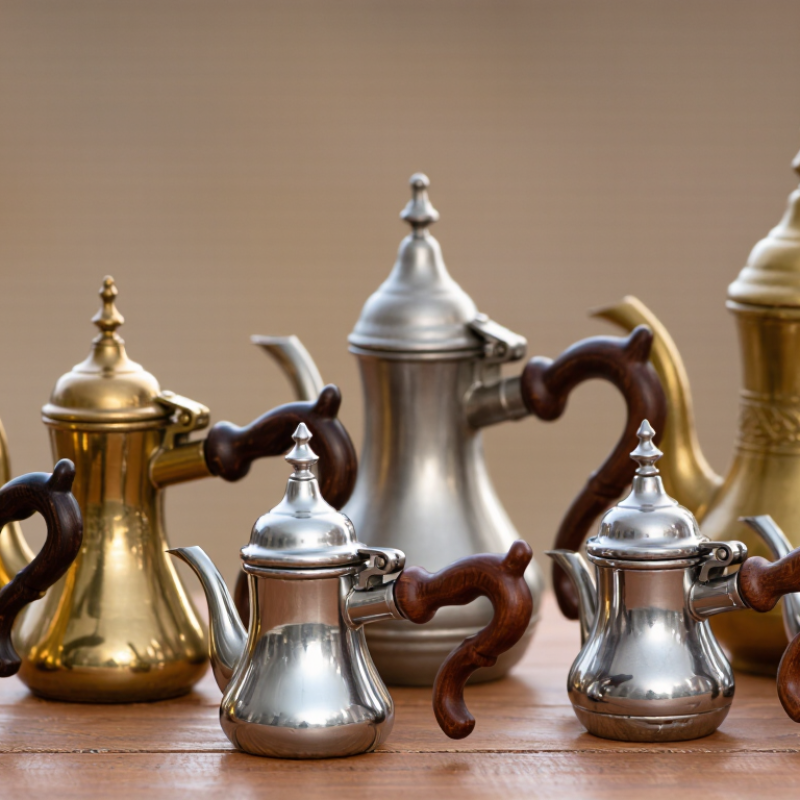
What Defines a Traditional Arabic Coffee Pot Dallah
A traditional Arabic coffee pot dallah is recognized by its rounded body, narrow neck, curved spout, and domed lid. Its silhouette should feel balanced, not merely decorative. The spout usually extends forward with a gentle sweep, allowing controlled pouring into small cups. A firm side handle protects the hand from heat. Some designs include a pointed finial on the lid, while others use a simpler knob.
Traditional dallahs are commonly made from brass, copper, stainless steel, or blended metals. Older handcrafted pieces may show subtle hammer marks, uneven lines, and variations in surface color. These details can reflect real workmanship. They are not always flaws. Still, rough joints, unstable handles, or a poorly fitted lid may indicate weak construction. A bright finish alone proves little.
In practical sourcing, examine the base, seams, lid movement, and spout opening. The pot should stand securely on a flat surface. Its handle should remain comfortable during repeated pouring. Inside, a smooth surface is easier to clean and less likely to hold coffee residue. Regional styles also differ in height, ornament, and proportions, so “traditional” has no single fixed shape. That point is often overlooked. A highly polished dallah may look impressive in photographs, yet a quieter, hand-finished piece can feel more authentic in use. The best choice balances cultural form, safe materials, reliable construction, and the daily rhythm of serving Arabic coffee.
| Supplier Profile | Typical Production Region | Recommended Dallah Construction | Common Materials | Traditional Design Features | Typical Capacity Range | Best Use Case for Global Buyers | Key Quality Checks | Suitability Rating |
|---|---|---|---|---|---|---|---|---|
| Traditional Metalware Workshop | Arabian Peninsula and Gulf craft markets | Hand-finished or semi-handcrafted serving pot | Brass, copper, stainless steel, or mixed metal construction | Rounded body, tall narrow neck, pointed finial lid, curved spout, and side handle | 0.5–3.0 liters | Heritage-focused retail collections, hospitality venues, and cultural gift programs | Check wall thickness, stable base, secure lid fit, smooth spout opening, and food-contact safety | ★★★★★ |
| Stainless-Steel Hospitality Supplier | Gulf-region commercial kitchen supply markets | Machine-formed pot designed for frequent service | Food-grade stainless steel, commonly 304-grade for durable food-contact applications | Classic silhouette with a polished or brushed finish; decorative elements may be simplified | 0.7–4.0 liters | Hotels, restaurants, cafés, airlines, offices, and high-volume catering | Verify stainless-steel grade, heat resistance, handle attachment, dishwasher guidance, and corrosion resistance | ★★★★★ |
| Decorative Brass and Copper Specialist | Regional metalcraft centers in the Middle East and North Africa | Decorative serving pot with polished, hammered, engraved, or plated surfaces | Brass or copper exterior; some products use a stainless-steel interior or liner | Engraved geometric patterns, crescent-shaped finial, ornamental handle, and pronounced spout | 0.4–2.5 liters | Premium interiors, ceremonial use, cultural displays, and upscale gift packaging | Confirm whether the interior is food-safe, inspect plating consistency, and test for exposed copper or lead-containing finishes | ★★★★☆ |
| Private-Label Export Manufacturer | Established kitchenware manufacturing hubs in Asia and the Middle East | Standardized production with customizable color, finish, packaging, and logo-free specifications | Stainless steel, aluminum, coated metal, or engineered combinations | Traditional body and spout proportions adapted for consistent batch production | 0.6–3.0 liters | Importers, distributors, online retailers, and multi-country product launches | Request material declarations, pre-production samples, carton specifications, leakage tests, and batch inspection records | ★★★★☆ |
| Small-Batch Artisan Cooperative | Craft communities across the Arabian Peninsula, Levant, and North Africa | Handcrafted or individually finished dallah with visible artisan variation | Hammered brass, copper, silver-colored metal, stainless steel, or traditionally finished alloys | Hand engraving, irregular hammered texture, distinctive finial, long curved spout, and decorative handle | 0.3–2.0 liters | Authentic cultural merchandise, museum shops, boutique hospitality, and collector markets | Review consistency between samples, finish durability, food-contact suitability, packing protection, and replacement availability | ★★★★☆ |
| Modern Tableware Manufacturer | International tableware and kitchenware production centers | Contemporary interpretation intended for everyday serving | Stainless steel, ceramic, cast aluminum, or heat-resistant coated metal | Recognizable dallah profile with simplified ornamentation and ergonomic handle design | 0.5–2.0 liters | Contemporary homes, cafés, restaurants, wedding venues, and modern retail assortments | Evaluate pouring control, thermal insulation, lid retention, base stability, cleaning instructions, and finish durability | ★★★★☆ |
| Ceremonial and Giftware Supplier | Specialty giftware markets in the Gulf and wider Middle East | Presentation-focused dallah supplied individually or in coordinated sets | Decorative metal, stainless steel, ceramic, wood-accented metal, or plated finishes | Highly visible finial, ornate surface decoration, curved spout, and presentation-oriented proportions | 0.25–1.5 liters | Corporate gifts, weddings, national celebrations, tourism retail, and cultural events | Confirm whether the item is functional or display-only, check packaging strength, surface protection, and accurate care labeling | ★★★☆☆ |
Traditional Arabic coffee pot characteristics generally include a rounded vessel, narrow neck, pointed lid finial, long curved spout, side handle, and a form designed for serving lightly roasted Arabic coffee. Capacity, materials, decoration, and manufacturing methods vary by region and intended use.
It usually has a rounded body, narrow neck, curved spout, and domed lid. The shape should feel balanced. Regional proportions may vary.
Common choices include stainless steel, brass, copper, and blended metals. Stainless steel is easier to clean and resists corrosion. Brass and copper need suitable interior protection for regular service.
Check the lid fit, spout alignment, handle strength, seams, and base stability. The pot should stand firmly on a flat surface. Look closely.
Fill the pot and pour slowly into a small cup. The stream should remain steady, without dripping around the spout. Sharp edges or loose joints require attention.
Not always. Subtle marks can reflect hand craftsmanship and natural production variation. However, unstable handles, rough joints, or badly fitted lids suggest weak construction.
Options may include capacity, handle shape, engraving, finish, packaging, and logo placement. Confirm drawings, colors, carton sizes, and acceptable tolerances in writing. Details matter.
One sample cannot prove consistent production. Compare samples from different batches when possible. Small changes can affect pouring comfort, appearance, and customer trust.
Include freight, insurance, duties, brokerage, local taxes, and destination charges. Carton dimensions and gross weight affect shipping costs. My first estimate may be wrong.
Request material specifications, coating details, batch records, packing photos, and a matching commercial invoice. For coffee service, ask for food-contact declarations and relevant laboratory reports. Local requirements still need checking.
This guide explores what makes a traditional Arabic Coffee Pot Dallah distinctive, including its recognizable silhouette, pointed spout, ergonomic handle, lid, and cultural role in serving coffee. It also explains how global buyers can assess suppliers by reviewing material quality, craftsmanship, production capacity, customization options, communication, and consistency. The article introduces seven notable supplier categories and sourcing choices without focusing on specific brands, helping buyers compare handmade and factory-produced options for different markets and budgets.
Key considerations include stainless steel, brass, aluminum, and decorative finishes, along with packaging, quality inspection, and product standards. The guide also outlines practical issues such as wholesale pricing, minimum order quantities, shipping methods, lead times, certificates, labeling, customs documentation, and destination-country import requirements. By evaluating these factors carefully, buyers can select a reliable Arabic Coffee Pot Dallah supplier and build a purchasing plan that balances authenticity, durability, presentation, and international logistics.